
THE LINUX FOUNDATION PROJECTS
Monthly Archives

December 2024

OpenAPI Initiative Newsletter – December 2024

By Blog

Welcome to our December 2024 newsletter, the final OpenAPI Initiative roundup of the year! Our newsletter brings you initiative news, details of new versions of our specifications, and information on events and educational resources.

Initiative News

In 2024 the OpenAPI Initiative (OAI) grew from one specification to three, with two new specifications added.

In May Arazzo version 1.0 was released. If you’ve not heard of Arazzo, it is a description language for describing sequences of API calls, and supports passing of dynamic data between steps. Arazzo is an attempt for API providers to help describe such sequences in an increasingly complex API-driven world, in order to reduce onboarding time for developers implementing flows and reduce cost and complexity.

October also saw the release of the Overlay Specification at version 1.0. Overlay is a specification for describing updates to an OpenAPI description document in a consistent, deterministic way. Overlay helps API providers update their OpenAPI descriptions through the API lifecycle, and supports building pipelines for API descriptions, supporting automation. Overlay and automation can help organizations manage the publication of their OpenAPI descriptions more accurately, with increased quality, at lower cost.

Finally the OpenAPI Specification was also uplifted to versions 3.0.4 and 3.1.1. Being patch releases these releases did not introduce new features, but sought to clarify features of the 3.0 and 3.1 specifications with a significant amount of new and revised supporting guidance added to the specifications. Updates include extensive guidance on modeling parameters, headers, and form data, handling URL percent-encoding, parsing documents and resolving references, and choosing which fields to use for examples. The specification now also link to the extension registries, the JSON Schema for OpenAPI Description documents, and the Learn OpenAPI site.

Looking ahead to 2025 there are already plans afoot for new versions of the OpenAPI Specification.

At the end of 2023 we announced project Moonwalk with an ambitious goal of shipping a major release by the end of 2024. While v4.0 of the OpenAPI Specification is still some way off, we have learned a great deal and are now planning v3.2 and v3.3 as incremental steps towards v4.0 that will be fully backwards-compatible with v3.1.

Version 3.2 is intended to deliver a small set of new features quickly in 2025. Two of these features, (hierarchical, categorizable tags and self-identifying documents, which take much of the pain out of external references) emerged from the Moonwalk effort. While the scope will no doubt evolve, other features under consideration include streaming JSON formats, additional HTTP methods, device authorization flow, and links to OAuth authorization server metadata. This sounds like a lot, but aside from the changes with tags, most of these features are straightforward.

Work on v3.3 will start immediately after 3.2, and will deliver bigger ideas from Moonwalk. Two areas under consideration – a major streamlining of parameter, header, and form data modeling, and expanded OpenID Connect features – were 3.2 proposals that could not be done quickly. A v3.3 release, which has no date at this time, lets us take incorporate more Moonwalk ideas to solve these problems thoroughly.

As for v4.0 itself, the Moonwalk effort motivated us to understand how the OAS is implemented, and how to ensure that the specification truly represents the needs of the community. Henry Andrews summarizes this introspection in his blog, where he lays out an idealized architecture. Moonwalk will continue to progress in 2025.

The work on new specifications and specification releases, the increased adoption of 3.1, and the significant interest in Arazzo and Overlay all bodes well for another busy year in 2025. You can read more about OAI moving from one to three specifications and plans for next year in our blog post covering the changes in the initiative and what will come next in our evolution.

Events

2024 was another great year for events, with our continued partnership with apidays plus an appearance at the JAX Mainz Conference. The OAI track appeared at apidays Singapore, New York, Helsinki, London, Australia, and finally Paris, with a huge array of different talks ranging from introductions to Arazzo, views on how OpenAPI helps with API governance, and the role of OpenAPI in the geospatial ecosystem. The range of talks, together with generally packed conference rooms, are indicators of both the health and interest in the OpenAPI ecosystem, and in the strategic value of openness and open standards in general.

Looking ahead to 2025, we already have an OAI-supported event in the train at DeveloperWeek, where Erik Wilde and Frank Kilcommins will be hosting the first OAI track of the year. Our OAI tracks have been features of apidays for the last two years, but DeveloperWeek brings the OAI to a large conference audience that is not dedicated to APIs. Broadening our reach and gaining the interest of communities outside the immediate API space will help widen the opportunity to attract new members who already use the OpenAPI Specification without even knowing it.

Outside the OAI tracks we also have TSC member Lorna Mitchell presenting at FOSDEM 2025 with an overview of the aforementioned expansion of OAI into three specifications. If you are planning or have a talk lined up on any aspect of OAI in 2025, let us know! We’d be happy to include it in the newsletter.

One other initiative we have started this year is our OpenAPI Hangouts, where members of the OAI community come together to discuss aspects of the specifications in a webinar style format, broadcast on LinkedIn and YouTube. We plan to expand these in 2025, covering more topics and engaging with more community members.

Education and Training

We’ve also taken steps in 2024 in education and training, with some improvements and new initiatives designed to help the understanding of our specifications in the community.

Our Learning site continues to develop, with valuable resources for explaining OpenAPI in a narrative format. The site includes great resources that include a detailed walkthrough of references, examples of OpenAPI descriptions sourced from the community, and details from new specifications like Overlay.

Alongside our learning site, in 2024 we also created our OpenAPI Fundamentals course, an online training course provided at Linux Foundation Training to increase awareness of the background, basic structure, and approaches to using the OpenAPI Specification. The course is available for free and provides a badge of completion.

We’ve also provided a number of in-person training courses, first at the Nordic APIs Platform Summit and then at apidays Paris. While participation in terms of number of attendees for these courses was mixed, they represented an important step in allowing us to investigate how we can better support the community for training and learning. We’ll continue to look for opportunities to support the community through in-person training in 2025, starting with a full-day workshop about “Practical API Management with OpenAPI” at DeveloperWeek in February 2025.

Finally

That’s it for this newsletter, and 2024! We’ve achieved so much this year, and that is down to our great teams of volunteers who support the development of our standards. Thank you so much to our community and all the contributors who bring our specifications to life. Happy holidays everyone!

As ever, we welcome suggestions on how we can improve this newsletter or bring you information that can help make the most of how you use specifications published by the OpenAPI Initiative. We are also looking for ways to highlight OpenAPI Initiative member contributions to the community. Please get in touch on the Outreach channel on Slack if you would like to work with us to tell your story.

Contributors: Chris Wood, Henry Andrews, Erik Wilde, Jeremy Fiel
Evolving OpenAPI in a Multi-Specification Initiative

By Blog

When people say “OpenAPI”, they are usually referring to the OpenAPI Specification, the API description language that helps us publish and consume APIs. The OpenAPI Specification is at the center of how the API community describes the shape of an API, allowing it to be readily understood.

However, you may not realize that the OpenAPI Initiative (OAI) has expanded beyond the core OpenAPI Specification. The needs of the API community have grown alongside the continued increase in scale of the API economy, and the community needs are reflected in the evolution of OAI to a multi-specification project. Our view of the world at the end of 2024 includes some significant developments over the last 12 months, with an equally exciting 2025 ahead. The OAI now incorporates the following projects:

  • OpenAPI Specification.
  • Arazzo Specification.
  • Overlay Specification.
  • OAS Comply.
  • Special Interest Groups (SIGs).

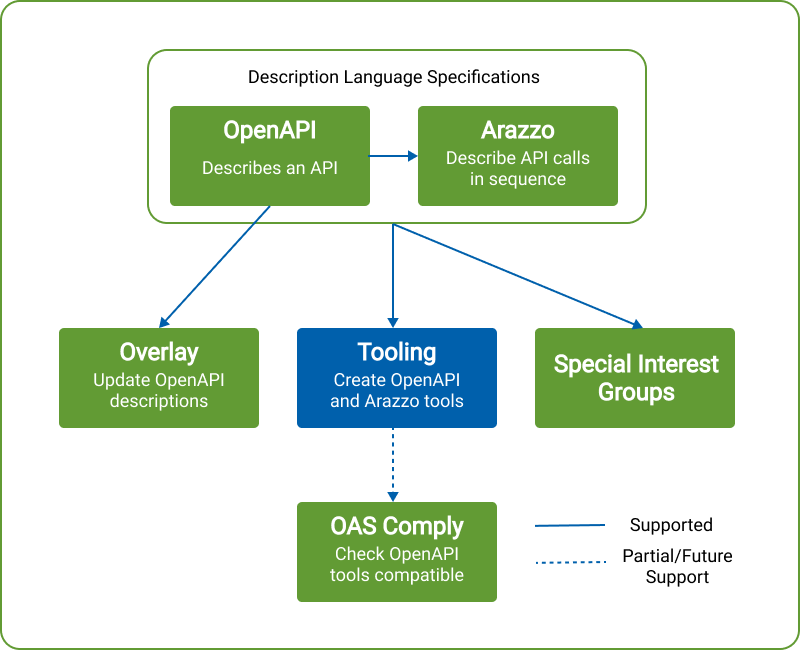
The tools, specifications, and groups that comprise the OAI project provide an increasingly large footprint of standards in the API economy. Their relationships are summarized in the diagram below, which shows how each tool, specification, or group fits into the OpenAPI ecosystem.

The specifications and tools that comprise the OpenAPI Initiative

Each of these provides features and functions important to the API community.

OpenAPI Specification

The OpenAPI Specification is the center of the OAI and the focus of our efforts to support the API community. OpenAPI is the most widely used API description language in the API ecosystem, with arguably the longest legacy, and supports the publication and consumption of an innumerable number of APIs throughout the API lifecycle.

The OpenAPI Specification is undergoing active development with support from dedicated volunteers, with a new major version coming soon focused on the semantic improvement of the specification and supporting AI use cases. The OAI is constantly evaluating how we can improve the development of the standard, and provide support for tooling makers who are implementing the specification.

OpenAPI is currently at version 3.1.1, with multiple versions planned to harmonize the features of the Specification in readiness for version 4.0.0, our next major version codenamed “Moonwalk”. You can read more about version 3.1.1 on our standards site and discover the goals of Moonwalk on our blog. We also released version 3.0.4 in 2024, again in an effort to harmonize guidance across different versions.

Arazzo Specification

The OpenAPI Specification was created to describe a single API and its supported operations. The API ecosystem has, however, grown significantly more complex as it has expanded, with a need to invoke multiple API operations across different API providers to complete a business operation. This growth in the interdependency of API operations has created a need for sequences of API calls to be described programmatically, which is why the Workflows Special Interest Group created the Arazzo Specification.

Arazzo is a description language that can reference multiple APIs, each described with an OpenAPI description or another Arazzo description, that provides API consumers with a rich view of complex, multistep workflows. Arazzo supports describing dynamic values, allowing API providers or API marketplaces to indicate how API operations relate to each other and the output and inputs that can be carried between each step. When supported by appropriate tooling this can significantly accelerate implementation time for API consumers and ensure they can handle sequences of API requests more accurately.

Arazzo is currently at version 1.0.0. You can read more about the Specification on our standards website.

Overlay Specification

The OpenAPI and Arazzo Specifications provide the backbone of the OAI, with description languages aimed at supporting use cases across the API ecosystem. OAI is also creating complementary specifications that help API providers and consumers publish and consistently work with OpenAPI descriptions.

An example of these efforts is the Overlay Specification, which is now at version 1.0.0. The Overlay Specification is intended to provide a consistent and deterministic way of applying updates to an OpenAPI description document. Example use cases include supporting multi-language API descriptions by using Overlays to contain language translations and including configuration information for different deployment environments in an OpenAPI description document.

OAS Comply

OAS Comply is an effort to develop tools to support tooling makers in implementing the OpenAPI Specification, with the potential to expand in the future to include the Arazzo Specification. The OASComply project was started in 2023 and was instrumental in understanding where the 3.0 and 3.1 specifications needed clarification.

The discoveries provided by OASComply motivated much of the work in the Open Specification 3.0.4 and 3.1.1 releases, as well as making compliance testability a major focus for Moonwalk. OASComply itself is on hold while we proceed with Moonwalk and figure out how compliance testability work might fit into our version 3 standards.

Special Interest Groups

Finally, OAI has Special Interest Groups that are focal points in evolving specific use cases across industries, verticals, or technology requirements. SIGs are an important means for channeling support for new ideas and initiatives, and it speaks volumes that the efforts to create Arazzo, Overlay, and Moonwalk are focused through SIGs.

The Future of the OpenAPI Initiative

The evolution of the OpenAPI Initiative has been largely organic and relied upon the endeavors of many dedicated volunteers. The members of the OpenAPI community have investigated, researched, discussed, and authored for thousands of hours to reach this point in the evolution of the OpenAPI Initiative.

Our next steps as an organization include:

  • Producing new versions of OpenAPI, including our next major version.
  • Maturing Arazzo and Overlay and helping tooling makers to support the specifications.
  • Expanding our support for both OpenAPI members and the community with investments in training, education, and certification.

If you are interested in helping develop the most important API description language on the Internet there is a huge opportunity for you. Join our Slack community to find out more.

Author: Chris Wood

AVAP Framework has just joined OpenAPI as a member!

By Blog

AVAP Framework has just joined OpenAPI as a member!

We are thrilled to announce that AVAP Framework, a cutting-edge API Lifecycle Management Platform, has officially joined the OpenAPI Initiative (OAI) as a proud member! This milestone reflects our commitment to innovation, collaboration, and advancing open standards in the API ecosystem.

What Is AVAP Framework?

AVAP Framework is a comprehensive suite of tools and services designed to streamline the entire API lifecycle—from design and development to deployment, maintenance, and beyond. At its heart is AVAP (Advanced Virtual API Programming), a specialized programming language tailored for creating virtual APIs that adapt seamlessly to evolving business and technology needs.

Central to AVAP Framework is Brunix, our AI-powered engine. Brunix optimizes processes, predicts solutions, and ensures that APIs are scalable, secure, and efficient across diverse environments. AVAP Framework’s universal compatibility ensures seamless integration with other technologies, enabling businesses to build flexible, resource-efficient, and future-ready APIs.

https://www.avapframework.com/ 


By joining the OpenAPI Initiative, AVAP Framework is aligning with the industry’s leading community focused on developing and promoting open standards for API design. Through this collaboration, we aim to contribute our expertise in virtual API programming, AI-driven innovations, and API lifecycle management to the evolution of the OpenAPI Specification (OAS).

Raúl Nogales, Founder & CEO of AVAP, will serve as our representative in the OAI. With his extensive experience in API innovation and technology, we are confident that AVAP Framework will add significant value to the OpenAPI ecosystem.

OpenAPI Resources

Want to become a member of the OpenAPI Initiative? Find more information here: https://www.openapis.org/membership/join 

To learn more about participating in the evolution of the OpenAPI Specification: https://www.openapis.org/participate/how-to-contribute

About the OpenAPI Initiative

The OpenAPI Initiative (OAI) was created by a consortium of forward-looking industry experts who recognize the immense value of standardizing on how APIs are described. As an open governance structure under the Linux Foundation, the OAI is focused on creating, evolving and promoting a vendor neutral description format. The OpenAPI Specification was originally based on the Swagger Specification, donated by SmartBear Software. To get involved with the OpenAPI Initiative, please visit https://www.openapis.org

About Linux Foundation

Founded in 2000, the Linux Foundation is supported by more than 1,000 members and is the world’s leading home for collaboration on open source software, open standards, open data, and open hardware. Linux Foundation projects like Linux, Kubernetes, Node.js and more are considered critical to the development of the world’s most important infrastructure. Its development methodology leverages established best practices and addresses the needs of contributors, users and solution providers to create sustainable models for open collaboration. For more information, please visit us at linuxfoundation.org.