
Welcome to the OpenAPI Initiative (OAI) February 2026 newsletter!
This is our first newsletter of 2026, and there is already plenty to share from the OAI community.
Initiative News
We’ve made a great start to 2026 in the Overlay world with completion of version 1.1.0 of the Overlay Specification. Version 1.1.0 brings several new features, including a new copy property for the Action Object, which can be used to copy or move an element in the OpenAPI document. This property is great for operations where you may already have a source-of-truth embedded in part of your API description, and want to use it across all operations. For example, you might implement a default Response Object and wish to copy it to all Operation responses to give more consistency for API consumers.
Other improvements include the ability to update primitive values – strings, integers, and so on – rather than updating the parent object, making Overlay documents more concise and easier to manage. The specification has also been updated for full compliance with RFC 9535, to ensure tooling makers are creating Overlay tools through guidance that is fully compatible with the latest JSONPath standards.
To learn more about upgrading, use this helpful guide. As always, new versions of our specifications are nothing without our community of contributors, so a huge thanks to Vincent Biret, Lorna Mitchell, Ralf Handl, and Michael Kistler for contributions, reviews, and support.
The Moonwalk Special Interest Group (SIG) has also entered 2026 with a new focus. The SIG will continue to explore concepts that go beyond the current OpenAPI v3 Specification, with a particular focus in the first six months of 2026 on how OpenAPI relates to large language models (LLMs) as a new class of API clients. The groups aims to investigate what additional metadata or structural information might be needed in OpenAPI documents to make them more “agent-ready” for LLM use, including capability discovery and intent signaling. Several open questions are being posed, including around surfacing capabilities, grouping functionality for agents, and optimizing descriptions for LLM-based workflows. You can find the full scope of this initiative here.
As always, initiatives as important as this do not create themselves (whatever the capabilities of AI), so the Moonwalk SIG is looking for new contributors and hosts to help in this important work. The Moonwalk SIG is every Tuesday at 1700 GMT / 0900 PST, with the agenda for each meeting published on the GitHub Discussions link above.
Building on the success of v3.2, and the continued great feedback we are getting from the community, we are looking to enhance our coverage of important API security specification in future versions, including the FAPI Security Profile, which is commonly used in open banking and open finance, and AuthZEN. We also have the Industry Standards Special Interest Group, which looks specifically at industry collaboration and how OAI specifications can meet the needs of API providers across a range of verticals. If you are interested in taking part the Industry Standards SIG to help foster collaboration across industries join the channel in Slack. You can also read the draft work plan for 2026 here to learn more about the goals of the SIG. SIG meetings are on Mondays at 1730 GMT / 0930 PST and are bi-weekly.
2026 promises to be another exciting year for OAI, with the growing opportunity of specification updates, collaboration with industry verticals and software foundations who rely on OAI specifications, and the exploration into greater compatibility with AI and agentic tooling. We are always on the lookout for new members, so if you are thinking of getting involved, becoming a member is one way of contributing to the work OAI does if you are unable to contribute through specification maintenance or taking part in SIGs. Head over to the membership page on our website to find out more.
Events News
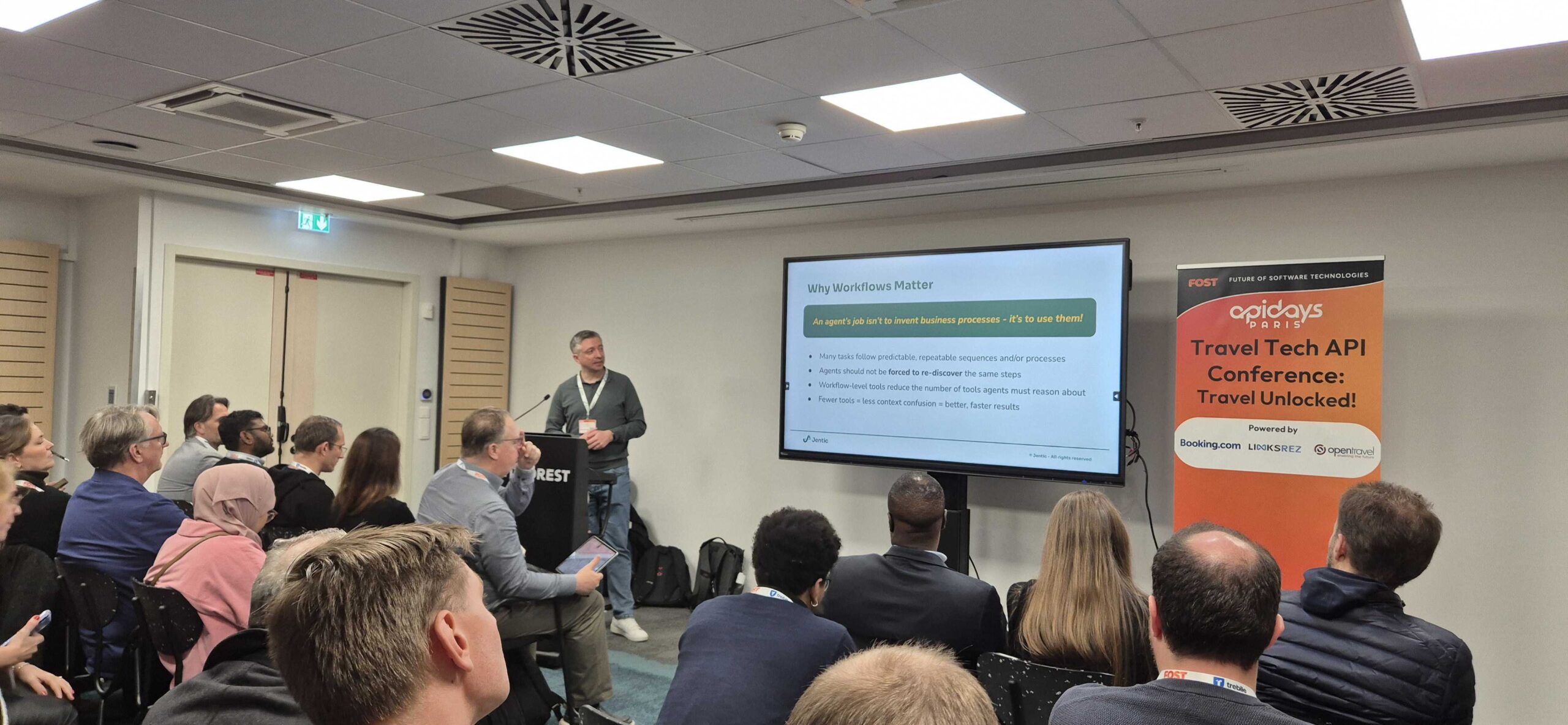
The end of last year saw our final event of the year, the Future of Software Technologies (FOST) – forever known as Apidays – Paris conference. The event attracted a huge number of delegates, speakers, and exhibiters, with APIs still obviously the key theme, but the role of AI, standards such as MCP, AI and agentic security, and the intersection between agents and APIs being key talking points throughout.
OAI hosted our own sub-conference, hosted by Erik Wilde and Frank Kilcommins with a stellar line-up from the OAI community and huge interest from the community with a packed conference room for most sessions. We saw speakers such as Emmanuel Paraskakis talk about API design in the context of AI-based design workflows, Marjukka Niinioja describe how to embed OpenAPI into daily workflows using Lean principles to eliminate API delivery waste, and Dimitri van Hees give an overview of the Dutch Government API developer portal and their OpenAPI-first approach for public sector APIs. Frank and Chris Wood also talked on the Travel Tech sub-conference and discussed Arazzo in the context of travel API workflows.
This year we’ll be keeping our focus on our successful partnership with FOST whilst continuing to develop new relationships with other conferences. To that end our first conference of the year is the OpenAPI Summit at DeveloperWeek, San Jose, with a full day of speakers focusing on all things OAI and AI. We have Henry Andrews providing an overview of v3.2 of OpenAPI, Sumit Amar focusing on using AI tools like Copilot and Cursor to automate API design, development, testing, and observability, and Kuldeepak Angrish and Budha Bhattacharya discussing how API standards and governance create the foundation for AI-readiness before implementing LLMs or MCP. Head over to our dedicated Events site for more details, including the sign-up link for Developer Week.
We also have Apidays Singapore, New York, and Munich – and of course Paris – already lined-up for this year. Stay tuned the newsletter and updated on our Events site and LinkedIn page for details as they are finalized!
Ecosystem Spotlight: Jentic AI-Readiness Scorecard
Our Ecosystem Spotlight focuses on the work of OAI members and the OAI community in general in using OAI specifications in tooling, products, and experiences. The Ecosystem Spotlight in this newsletter is provided by Jentic, an OAI member who leverages both OpenAPI and Arazzo to provide deterministic and reliable agentic workflows.
As AI agents become first-class API consumers, a question emerges that linters can’t answer: can an agent actually reason about this API, and use it safely?
Jentic’s AI-Readiness Scorecard addresses the gap between specification validity and machine usability. A syntactically correct OpenAPI document guarantees grammar conformance, not that an agent can interpret intent, construct valid requests, or handle errors gracefully. Developers compensate for ambiguity through trial and error; agents either halt or worse, proceed with confident but incorrect assumptions.
The scorecard evaluates APIs across six dimensions: foundational compliance, developer experience, AI interpretability, agent usability, security, and discoverability. Each dimension produces rich diagnostics that pinpoint exactly where improvements yield the highest gains for both human developers and AI agents. Analysis of 1,500+ APIs revealed consistent obstacles: missing server definitions, authentication buried in prose rather than the spec, sparse or contradictory examples, and broken schema references.
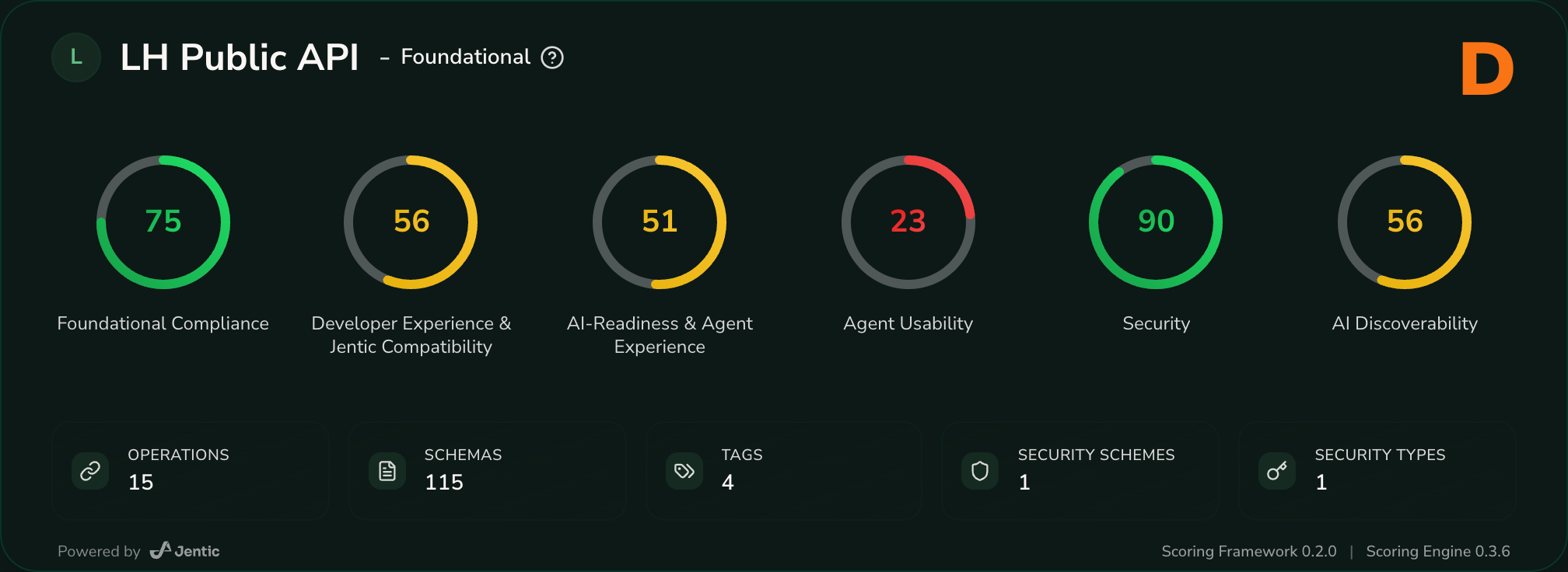
“AI systems don’t just scan API descriptions; they must interpret, reason, and act on them reliably,” notes Frank Kilcommins, Head of Enterprise Architecture at Jentic and co-author of the Arazzo Specification. “The scorecard provides concrete benchmarks and rich diagnostics on score breakdowns, so you know where you are and what investments will return the most reward. We’re building automatic improvement capabilities leveraging the Overlay specification, helping teams move from insights to actionable fixes.”
You can learn more about the scoring framework, and/or try it for free with your own APIs at https://jentic.com/scorecard.
Finally
Thank you for reading our newsletter. As always, we welcome suggestions on how we can improve it or bring you information that can help make the most of how you use specifications published by OAI. Please get in touch on the Outreach channel on Slack if you would like to work with us to tell your story, to feature in the Ecosystem Spotlight section, or get involved with any of the initiatives described above. We’d really like to hear from organizations, tooling makers, or community members who have success stories to tell, so we can celebrate their successes on the blog.
Until next time!
Contributors: Frank Kilcommins, Henry Andrews, Lorna Mitchell, Ruth Cheesley, Chris Wood.